Latest Posts

The National Trust for the Cayman Islands: 30th Anniversary


Since its inception in 1987, The National Trust for the Cayman Islands has been dedicated to the conservation of both our island’s heritage and environment.  The exceptional staff and volunteers do a tremendous job to ensure that future generations will have the opportunity to enjoy and cherish our island’s history, national monuments and parks as well as protected environmental areas.  If such assets to our islands that enriches our community are not protected then sadly they may become lost, destroyed or even forgotten.  Thirty years of preservation and conservation by the National Trust for the Cayman Islands is a proud and monumental milestone for the non-profit.  It is one most deserving of being celebrated as are our historic and environmental sites that the National Trust of the Cayman Islands are custodian of.  Some of the popular sites that have become very dear to the hearts of locals and tourists include: the Mission House, Mastic Trail, Queen Elizabeth II Botanic Park, and the Blue Iguana Recovery Program

On Saturday, 23rd September 2017, at Pedro St. James Castle from 7-10pm the public are invited to celebrate the 30th anniversary of the National Trust for the Cayman Islands.  Pedro St. James Castle, is the perfect venue to host such an event as it is one of the most iconic and beloved historic sites in Grand Cayman.  This public celebration is one not to be missed, and will include live music and entertainment by Cayman traditional kitchen band Swanky, Ken and Ben, called The Duo and James Geary.  Attendees will have the opportunity to indulge in local food (on sale) and complimentary drinks and canapés. The event is open to the public and is free for members of the Trust; non-members can attend an entry fee $30, which will include Trust membership.  Part of the proceeds from the event will be donated to the Trust’s Caribbean partners that were affected by Hurricane Irma.

For more information: email info@nationaltrust.org.ky or call 749-1121.

Down The Rabbit Hole: A Day Trip to Oxford


Oxford is a magical place. It’s no wonder Lewis Carroll was inspired to write the equally enchanting adventures of Alice in Wonderland here. Here, in a place not more than two short hours from the bustle of London, even the River Thames is quelled by the English countryside’s mystic green. But don’t be mistaken, Oxford isn’t a sleepy green hollow for shisha smoking catapillars. It’s heart beats in synchronicity with London’s as commuter trains connecting the two pump life both in and out. Gaining speed as they rush towards the capital, the trains transform, much like the river, into a proper London rush before turning around to carry escapees to a quieter reality (or wonderland).
Oxford’s magic is in its dual identity of countryside haven and bustling academic epicentre. But whether you are a London day-tripper or a resident Oxford student the city provides all the escape you need. A stroll through the university’s Botanical Gardens will inspire your imagination as you gaze at ferne leaves bigger than yourself with stems as round as your whole body — maybe they complied with an “eat me” label at some point too!
Continuing your stroll through the city, you will encounter the fantastic architecture of the various Oxford University colleges that stud the city with sculpted wonders and jewel-toned stained glass. Take it all in by climbing the narrow 127 stairs up the Church of St Mary the Virgin’s bell tower where you will be rewarded with a breathtaking panoramic of the spired skyline that inspired Matthew Arnold.
While a walking tour of Oxford University will grant you access to a great many more wonderful places of breathtaking architecture, you will gradually become aware of the secret Oxford not privey to your eyes. Indeed, the world we see and the world available to resident students are not the same and one can only image what other undiscovered rabit holes there are to explore–like the library beneath Radcliffe Camera.
If you are in search of more magic, however, you will be amiss not to visit Alice’s Shop on 83 Aldate’s Street. This adorable cubby was originally the sweets shops frequented by real-life Alice Liddell who inspired Carroll’s books. Today, it tempts its guests with a variety of Alice themed gifts and treats. When you’ve finished emptying your coin purse on mad hatter tea and watercolor postcards of Oxford scapes infused with wonderland residents, you will find Town Hall not far up the road. A short climb to the second floor will treat you to the sorbet-coloured views of the Victorian Hall.
Of course, there a number of other ways to occupy yourself in Oxford. From the various free museums and libraries to cozy pubs and Harry Potter scene hunting you’ll easily spend a full day entrapped in the city’s enchanting atomsophere. Just don’t be late (much to late!) for your train back to London!
________
Tiffany is a London based blogger, photographer, and writer who loves exploring new places both within her city and the across the globe. You can explore Tiffany’s work on her blog, MyHappyCoincidence.wordpress.com, and see her photos on Instagram. In addition to writing, she loves photography and is rarely found without a camera in her hand.


A Call to Action: Help Shark Conservation. Adopt a Shark.

As custodians of our stunning coral reefs and charismatic marine life, for over 30 years the Cayman Islands Department of Environment (DOE) has been protecting our island’s precious marine environment by establishing marine parks. Since 2015, the DOE increased marine protection by designating Cayman’s waters as a sharks and rays sanctuary, under the National Conservation Law. In part of DOE’s shark conservation efforts, shark research is an ongoing project to gather data about Cayman’s shark populations and monitor their behavior and patterns. Additionally, CayBrew’s Whitetip Fund supports DOE’s shark project with a focus on tagging sharks to improve shark research and conservation efforts in the Cayman Islands. The shark project utilizes four methods as a means to comprehensively gather pertinent data about Cayman’s sharks. The methods used are: tagging with an acoustic transmitter, BRUV (baited remote underwater video) surveys, photo identification of individual sharks and shark sighting logging. To read more about this ongoing project click here

Sharks are of significant value to our coral reefs and other marine environments. According to a report by Marine Conservation International and the Cayman Islands Department of Environment (DOE) the added value to marine tourism of having sharks on the reef is about US$54 million per year. Sharks are worth more alive than dead! To ensure the balance of the marine ecosystems are in check, we need healthy populations of sharks. Sharks play an integral role in maintaining the health and balance of marine ecosystems. As advocates for sharks and ocean conservation, in an united effort we can help to protect sharks and other marine life through the conservation of our oceans.

Donate to Cayman’s shark project

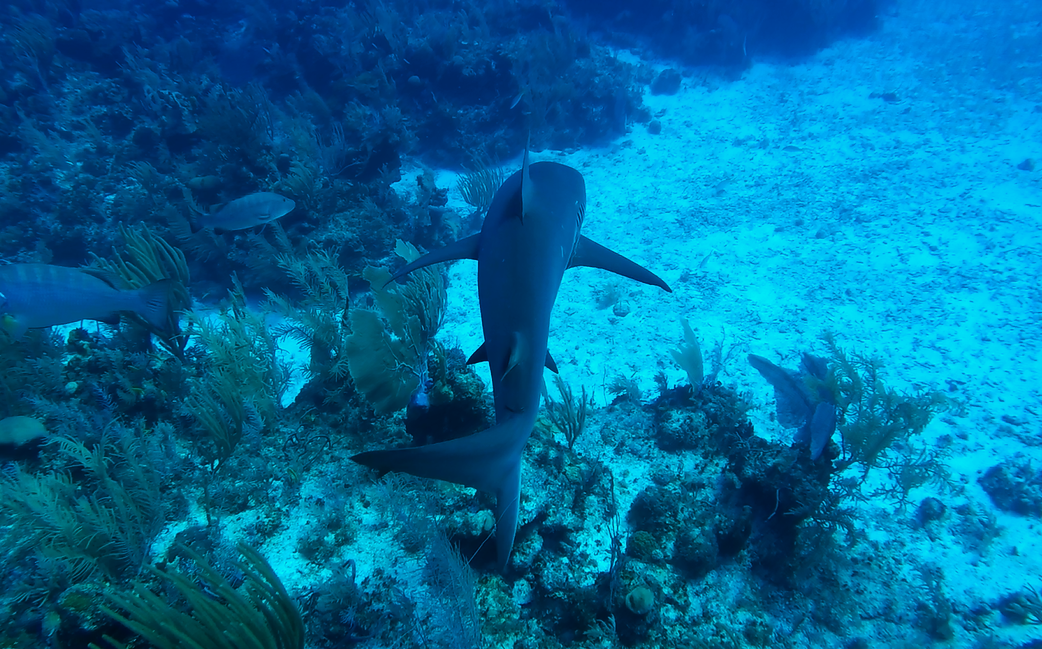
Caribbean reef shark (Carcharhinus perezi) on Grand Cayman. Photo Credit: Johanna Kohler

Cayman’s shark research relies on external funding and donations. Please support the DOE shark research team to help protect our sharks in the Cayman Islands. By simply, donating your time or money (no matter how small the amount) to this project will help the Cayman Islands Department of Environment to achieve their goals working towards the betterment of shark conservation. 100% of the donation will go directly to shark conservation in Cayman.

For more information on donation packages email: sharKYresearch@gmail.com

If you would like to become a sharklogger, please email: sharkloggers@gmail.com

Sponsor an Acoustic Transmitter and Adopt a shark

Caribbean reef shark (Carcharhinus perezi) on Grand Cayman. Photo Credit: Johanna Kohler

The DOE/MCI shark research relies on independent funding and support. The research team is planning on tagging more sharks with acoustic transmitters within the next 3 years. Corporations and other organizations can play a role in helping the DOE to better understand sharks. Adopt a shark! Corporations can make a donation to purchase an acoustic transmitter or receiver and in return for their commitment to help sharks, they can name the shark that is tagged. For further details and information on donation packages please contact: sharkyresearch@gmail.com


Behind the Scenes: Working with Sharks

Watch this video to see what a typical day of shark research and tagging is like.

Resources

Johanna Kohler

SaveSave

Sharks of the Cayman Islands

The Cayman Islands are known for being a popular diving destination in the Caribbean with over 365 dive sites. Some of the main attractions of dive sites in the Cayman Islands include wreck diving at famous shipwrecks such as, the Kittiwake, the Balboa, the Oro Verde as well as our biodiverse reefs. In order to help maintain our status as a diving destination hotspot, the Cayman Islands for over 30 years, has been protecting its marine life and reefs with Marine Parks. In 2015, the Cayman Islands increased their ocean conservation as the National Conservation Law effectively put protection measures in place for sharks and rays. Sharks are an apex predator, at the top of the marine food chain, as a result they regulate the species at lower down the chain levels, helping to keep marine ecosystems such as reefs balanced. Sharks therefore are a considerable asset to our islands reefs and other marine ecosystems. Additionally, sharks are beneficial to ecotourism as many visiting snorkelers and divers are keen to see large charismatic marine life, and sharks tend to be one of the main attractions. According to a report by Marine Conservation International and the Cayman Islands Department of Environment (DOE) the added value to marine tourism of having sharks on the reef is about US$54 million per year. For divers and snorkelers, seeing a shark is both a privilege and a highlight. There are 8 species of sharks commonly found in the Cayman Islands, including: Great Hammerhead, Nurse shark, Lemon shark, Caribbean Reef shark, Blacktip, Tiger shark, Oceanic Whitetip and Silky shark. Amongst the variety of shark species found in the Cayman Islands, some species of sharks reside in Cayman waters all year long and inhabit coastal waters. Whereas, other species of sharks are pelagic and seasonally pass through Cayman while on migratory routes.

Coastal Sharks

There are four common species of coastal sharks that can be found in the Cayman Islands: Nurse sharks, Lemon sharks, Caribbean Reef sharks, and Blacktip sharks. They frequently inhabit areas including mangroves, turtle grass, sand beds and coral reefs. Coastal sharks tend to inhabit shallow, near shore regions.

Nurse Sharks (Ginglymostoma cirratum)

Nurse shark (Ginglymostoma cirratum) resting under a coral head on Grand Cayman. Photo Credit: Elly Wray

Nurse sharks tend to be known for their docile behavior. Some might even refer to them as the “puppies” of the ocean as some may demonstrate a friendly demeanor. Nurse sharks are creatures of habit. Once they find a favorite resting spot(s) they tend to frequently inhabit that area. In some instances, nurse sharks can be found “hiding” under coral or tucked away in shipwrecks as they rest during the day and are more active at night. An interesting fact about nurse sharks is that they are one species of sharks that is able to rest on the sea floor and actively pump water over their gills. Nurse sharks are typically found in tropical and subtropical waters at depths up to 240ft. Unfortunately, Nurse sharks often fall victim to a case of mistaken identity, as they are often mistaken for Lemon sharks. This is a result of Nurse sharks and Lemon sharks being similar in body shape and coloration. Nurse sharks vary from a dark grey to yellow brown in coloration and can grow up to 14ft in length.

Facts about Nurse sharks

• IUCN Conservation Status (Red List): *

Data Deficient (Globally)

Least Concern (Central America & Caribbean)

• Population Trend: Unknown

• Life Span: unknown but thought to be around 25 years

• Max Length: ~14ft (430cm)

• Reproduction: Ovoviviparous

• Gestation Period: 5-6 months

• Litter Size: 20-30

• Size at Birth: ~ 12 inches (31cm)

• Mating Cycle: Every 2 years

Below is a helpful chart showcasing similarities and differences between Nurse sharks and Lemon sharks.

Lemon Sharks (Negaprion brevirostris)

Juvenile Lemon shark (Negaprion brevirostris) near mangroves on Little Cayman. Photo Credit: Johanna Kohler

Lemon sharks, as their name suggests, are recognizable due to their yellow brown color. They grow up to 11ft in length. Lemon sharks are found in the tropical Western and Northeast Atlantic and East Pacific. Lemon sharks are quite adaptable to varying water conditions. They are among a few shark species that are tolerant of relatively high water temperatures. Due to living in shallow coastal waters, Lemon sharks can also adapt to water conditions with low salinity and low oxygen concentration levels. Lemon sharks have been known to be fairly gentle and non-aggressive, but – as with any wild animal one must always be careful and alert.

Facts about Lemon Sharks

• IUCN Conservation Status (Red List): * Near Threatened (Globally)

• Population Trend: Unknown

• Life Span: ~ 25 years

• Max Length: ~11ft (340cm)

• Reproduction: Viviparous

• Gestation Period: 12 months

• Litter Size: 4-17

• Size at Birth: ~ 20 inches (31cm)

• Mating Cycle: Every 2 years

Caribbean Reef Shark (Carcharhinus perezi)

Male Caribbean reef shark (Carcharhinus perezi) on Grand Cayman. Photo Credit: Johanna Kohler

As the name suggests, Caribbean Reef sharks are typically found in the Caribbean as well as Gulf of Mexico and Western Atlantic Ocean. Due to their preference to inhabit Caribbean waters, these sharks are inclined to stay near to a shallow coral reef habitat. They particularly like reef drop offs and outer reef walls. Caribbean Reef sharks are known as one of the apex predators in the coral reef system and they prey on a variety of reef fish and squid. As a result, their presence is important to help maintain a balance of reef fish. Caribbean Reef sharks have been known to be mistaken for a Blacktip sharks due to their similar body shape and coloration.

Facts about Caribbean Reef sharks

• IUCN Conservation Status (Red List):* Near Threatened (Globally)

• Population Trend: Decreasing

• Life Span: 25 years

• Max Length: historically up to ~9ft (2.8m), but now ~7ft (2.2m) due to fishing pressure.

• Reproduction: Viviparous

• Gestation Period: 12 months

• Litter Size: 4-6

• Size at Birth: ~ 29 inches / 74cm

• Mating Cycle: Every 2 years

Below is a helpful table indicating the differences between Caribbean Reef sharks and Blacktip sharks

Blacktip Sharks (Carcharhinus limbatus)

Blacktip shark (Carcharhinus limbatus) captured on BRUV survery, Dept. of Environment. Photo Credit: Johanna Kohler.

As the name suggests, Blacktip sharks get their name due to the black tips or edges found on their pectoral, pelvic and dorsal fins. Blacktip sharks are considered to be very timid and as a result they tend to be skittish and try to avoid divers. This makes it rather difficult to encounter Blacktip sharks as they are very shy and swim fast. Blacktip sharks can be found in tropical and subtropical coastal waters in depths up to 100ft.

Facts about Blacktip Sharks

• IUCN Conservation Status (Red List): * Near Threatened (Globally)

• Population Trend: Unknown

• Max Length: ~5.5ft (1.7m)

• Life Span: at least 12 years

• Reproduction: Viviparous

• Gestation Period: 11-12 months

• Litter Size: 1-10

• Size at Birth: 22-24 inches / 56-61cm

• Mating Cycle: Every 2 years

Pelagic Sharks

Pelagic sharks, also known as oceanic sharks, love open waters. They inhabit open waters of the oceans and seas. Various species of pelagic sharks are known to visit Cayman waters on their migratory route. During their voyage through our region they can typically be found in deep waters just offshore, yet may come for a visit to our reefs.

Great Hammerhead Shark (Sphyma mokarran)

Great Hammerhead shark (Sphyrna mokarran) on Grand Cayman. Photo Credit: Living the dream divers, North Wall

Great Hammerhead sharks are the largest of the hammerhead species, reaching up to 18-20ft long. They are found in tropical coastal and open waters worldwide. Great Hammerhead sharks have a tendency to be lone travelers and seldom travel in groups. A cool fact about Hammerhead sharks is that their “hammer” shaped head combined with electro-pores allows them to use the Earth’s magnetic field to navigate throughout the oceans. Hammerhead sharks famous for their “hammer” shaped heads, are an endangered species. Populations of this species of shark have declined by more than 80% in the last 25 years.

Facts about Great Hammerhead sharks

IUCN Conservation Status (Red List): * Endangered (Globally).

• Population Trend: Decreasing

• Max Length: ~18-20ft (6.0m)

• Life Span: 20-30 years

• Reproduction: Viviparous

• Gestation Period: 11 months

• Litter Size: up to ~50 pups

• Size at Birth: 23-27 inches / 58-69cm

• Mating Cycle: Every 2 years

Tiger Sharks (Gladeocerdo cuvier)

Juvenile Tiger shark (Galeocerdo cuvier) captured on BRUV survey by the Dept. of Environment. Photo Credit: Johanna Kohler

Tiger sharks get their name from their visually striking striped pattern that resembles that of a tiger. Their name might give the impression that they are fast swimmers, however, they are actually relatively slow. Tiger sharks can be found in tropical and subtropical oceans in both coastal and open waters. Tiger sharks prey mainly on rays and turtles. The deepest known sighting of a Tiger shark in the Cayman Islands was seen at the Cayman trench at just shy of 900ft.

Facts about Tiger Sharks

• IUCN Conservation Status (Red List): * Near Threatened (Globally)

• Population Trend: Unknown

• Max Length: ~18-20ft (5.5->6.0m)

• Life Span: 20-50 years

• Reproduction: Ovoviviparous

• Gestation Period: 16 months

• Litter Size: 10-80

• Size at Birth: 20-35 inches / 50-89cm

• Mating Cycle: Every 2 years

Oceanic Whitetip Sharks

Oceanic Whitetip sharks have distinctive white marks on the tips of their fins. They are epipelagic and as such live predominantly in the upper 660ft of the ocean water column and can often be found near the surface of water. They are active both day and night and move at a slow pace. In the past 50 years, world fisheries have drastically reduced their populations. Specifically, in the Gulf of Mexico, their populations have dramatically declined by 99.3%.

Facts about Oceanic Whitetip

• IUCN Conservation Status (Red List): * Vulnerable (globally) Critically Endangered (Gulf of Mexico)

• Population Trend: Decreasing

• Max Length: ~13ft (4.0m)

• Life Span: unknown but thought to be around 25 years

• Reproduction: Viviparous

• Gestation Period: 10-12 months

• Litter Size: 1-15

• Size at Birth: 23-25 inches / 58-64cm

• Mating Cycle: Every 2 years

Silky Shark (Carcharhinus falcifromis)

Silky sharks are known to be largely pelagic, inhabiting the open ocean. However, on occasion immature sharks can be found in coastal reef systems. Silky sharks are known to have smooth skin, silk like, and hence their name. They are relatively small sharks, but have distinctly large eyes and are swift swimmers.

Facts about Silky sharks

IUCN Conservation Status (Red List): * Near Threatened (globally)

• Max Length: ~5.5ft (1.7m)

• Life Span: at least 12 years

• Reproduction: Viviparous

• Gestation Period: 6 months

• Litter Size: 1-10

• Size at Birth: 22-24 inches / 56-61cm

• Mating Cycle: Every 2 years

What to do with a hooked shark?

Male Nurse shark (Ginglymostoma cirratum) with hook and line remains on Grand Cayman Photo Credit: Indigo Divers

Despite protection measures, sharks are still threatened by local fishing in Cayman. Fishing and fishing charters are popular among Caymanians, residents and visitors. Although fishermen don’t target sharks, no fishing methods is 100% selective. This is why sharks may bite the bait or get caught by going for the snapper or grouper struggling on the line. The accidental catch or by catch of sharks is still a significant threat to our local populations. If these sharks die, it will have a massive negative impact on our shark populations. Compared to other fish, sharks grow rather slowly, mature late (some sharks mature when they are 8 – 20 years of age), have long gestation periods ((they are pregnant for up to 1.5 – 2 years) and produce relative few young. These life characteristics limit the reproduction rate of a shark population and its ability to replenish itself quickly. Additionally if immature sharks are killed before they are able to reproduce they miss their chance to contribute their genes to the next generation.

The DOE recommends the following for the release of sharks in case of accidental shark catch:

Using extreme caution attempt to:

• Cut the hook and remove hook from shark OR Cut the line as close to the hook as comfortable

• Use non stainless steel hooks

• Use Circle Hooks

• Keep fight/handle time short to reduce stress and trauma on the shark

• Report the incident to DOE

Sharks have incredible self-healing powers and a strong immune system. Once the hook is out (either cut or rusted away) the hook wound will heal quickly.

Caribbean Reef Shark (Carcharhinus perezi) with hook on Grand Cayman

Resources

Johanna Kohler

Cayman Islands Department of Environment (DOE)

* The International Union for Conservation of Nature (IUCN) “Red List” summarizes the conservational status for each species (http://www.iucnredlist.org/).

Authors

Johanna Kohler and Laura Butz

SaveSave

Working with Sharks

Ever wondered what it would be like to be a shark researcher for a day? Today’s feature is a Q&A with Johanna Kohler, Shark Project Research Officer at the Cayman Islands Department of Environment.  Johanna Kohler is an accomplished Marine Biologist, specializing in shark behavior and ecology, currently based in the Cayman Islands. She has gained valuable experience from both, working and traveling, all over the world, giving her an impressive portfolio in the field. As an advocate for ocean conservation, Johanna Kohler is passionate about protecting and preserving sharks. Her respect and love for sharks is evident through her commitment to study sharks in order to gain valuable insight for the betterment of shark conservation. Sharks are majestic creatures that have unfortunately been misunderstood. As a result sharks are mostly portrayed in a negative light, resulting in them being wrongly feared. In actuality what we should be afraid of is an ocean without sharks, not an ocean with sharks. Sharks play a vital role in regulating the health of the ocean and keeping marine ecosystems in check. A healthy shark population is vital to ensure healthy coral reefs and thriving fisheries. One of the greatest threats sharks face is mankind. Shark populations have drastically declined over the last decades due to sharks being slaughtered for their fins, meat, liver, skin and teeth around the world. According to the IUCN red list, many species of sharks are now threatened or even endangered. Great strides have been made globally to increase the protection of sharks by way of establishing shark and ray sanctuaries as well as marine protected areas. Education along with conservation is key to ensure the protection and preservation of sharks worldwide and locally. A disconnect develops when one fears what they do not understand. Therefore, shark research is important, as it is a means to understanding more about sharks and debunking myths about them. Through education, one can begin to change the general public perception of sharks to make humans realize that sharks are not man eating monsters, but rather shy animals that are beneficial to our oceans. Johanna Kohler supports educational outreach in schools and to other occasions such as shark talks in bars and diving centers. She believes in the saying: You protect what you love and can only love what you know. For Cayman’s people to get to know sharks, she spearheaded the SharKY Fest last year. The Fest was a celebration of the first anniversary of the shark protection measures which came into force April 2015 in the Cayman Islands. The SharKY Fest involved local businesses, families, schools, the National Trust, Ellen Cuylaerts, divers and diving centre, fishermen, and the shark project’s main sponsor CayBrew.

Read below what it is like to study and work with Cayman’s sharks and what drives her to continuously work towards a better understanding and protection of these fascinating animals.

Interview with a shark researcher – Johanna Kohler

Notes: Johanna Kohler, Dept. of Environment, during the download of the acoustic receiver array on all Cayman islands. Photo Credit: Johanna Kohler

1. What inspired you to become a shark researcher?

Ever since, I have been fascinated by the ocean and its inhabitants. In High School I’ve enjoyed all science classes. Between my high school degree and university, I’ve gained more knowledge and hands-on experience in various fields of marine biology. Working with and in the marine environment to conserve and protect it, is my passion. Due to my travels, volunteering, diving and work experiences, I’ve become conscious of the impact of anthropogenic activities, including eco-tourism, on the marine environment. Especially, the work as dive instructor on Cyprus, has influenced my perception. During my dives, I had the opportunity to compare the remains of a former magnificent ecosystem under a dynamite fishing regime, on the Greek side of the island, to the fauna and flora of protected artificial reefs, and the Turkish side of the island, where no dynamite fishing had taken place. Sharks in particular fascinate me. I love the way they move. Next to my studies I’ve enjoyed working alongside leading scientists in the field which only increased my interest and passion for these amazing animals. Realizing that we still know so little about them which leads to many myths causing people to hate and kill sharks, inspired me to become a Marine Biologist to study these misunderstood animals. I intend to use my knowledge to develop better ways of protecting the marine environment and its wildlife, as well as teaching others about it in turn.

2. What is the key role(s) or aspect(s) of your job?

As part of the Shark Project research team the main aspect of my job is to monitor the relative abundance and behavior of our sharks species in Cayman. The monitoring involves various methods including BRUV (Baited Remote Underwater Video /i.e. camera traps) surveys, acoustic telemetry, photo identification and the Sharkloggers, a citizen science initiative. My job is it to plan and execute each survey to ensure data collection. One other aspect of my job is to investigate further the movement and ecology of our sharks populations, also with regards to Marine Protected Areas, to improve and inform conservation management. I’m also leading the Sharklogger programme which involves working closely with diving centers and recreational divers in order to track the movements and behavior of our sharks. When divers report sharks to the DOE (dead or alive), my job is it to archive the sightings in the DOE database. Since I’ve started out as dive instructor, I love this part of my job. Lastly, I give talks in schools and to other occasions to promote public awareness of sharks and the shark conservation legislation amongst local communities as well as to share new research findings.

3. Describe a typical work day?

This varies a lot day – to -day and with season. During a field season I’m on the boat every day, mostly all day, to collect data. Depending on the work that has to be done, I’m either deploying BRUVs (Baited Remote Underwater Video Systems) or dive to download the acoustic receivers or collect footage and behavioral data from our sharks. When we tag sharks with acoustic transmitter it may also involve boat work during some nights depending on the species that we want to tag. Sometimes I spend half the day on the boat and the other half to clean and preparing the gear for our next trip as well as with data analysis in front of the laptop. When the field season is over, I spend the time going through the data and work on analyzing the information which involves a lot of desk and laptop work and some occasional days on the water.

4. What is it like traveling for work to various diving locations?

I love to work in the field and I consider myself lucky to be able to work in the stunning Cayman waters and dive all these amazing sites. Despite the desk work during off season, I get to spend most of the year in/on the water with these fascinating animals. Travelling to different places is exciting and fun, but can become hard work when you have to plan the logistics of your gear. One trip to the sister islands involves packing 5 – 13 boxes of gear, transporting them to Cayman Airways Cargo, sending them off and collecting them on the other side, and unpacking everything before we can even begin the work. When it’s time to head back to Grand Cayman it’s everything all over again. Despite the challenging logistic in terms of our equipment, I love to travel to the sister islands. There is something special about them and the diving is amazing.

5. What advice would you give students interested in becoming a shark researcher?

The DOE research team deploys an acoustic tag on a tiger shark at night on Grand Cayman. Johanna Kohler and Dr Mauvis Gore (Marine Conservation International). Photo Credit: Michael Maes.

Get hands – on experience in the field. I grew up in the middle of Germany, far away from any ocean. I had to make plan to gain the necessary practical skills. Before and during my studies I’ve volunteered and shadowed marine biologist in the field. This way I got boat and diving experience, worked in aquariums and helped other PhD students with their fieldwork. This way I got to work with sharks from the start and became more and more skilled in handling the animals as well as working on the water.

Register at a University. I’ve attended all science classes in high school which helped me when I started University. To major in Marine Biology and Oceanography you will have to attend chemistry, physics, mathematics, biology and statistics. Don’t skip these. These subjects are fundamental to build upon and the broader you start out the better your basis of knowledge.

Work really hard. I’ve worked and volunteered on weekends which involved really early mornings, longs days or late nights – all in my spare time. If I had a day free of lectures I would work on my desk work ahead of time so that I could spend the day in the field volunteering.

Be like a sponge. Marine biology comes naturally to me. This of course makes it easier to understand and remember things I read or someone explains to me. Ask lots of questions when you volunteer in the field. When I’ve worked with more experienced people I would ask thousands of questions – and I still do – to learn from them. You never stop learning, there is always room to improve.

Read and write as much as you can. When it is your passion you will want to find out more about a certain topic. Ask questions. Practice your scientific writing skills but also make sure you are able to explain the science to members of the public that may not know that much about science. As scientist and shark researcher it is important to be able to communicate the research finding with the public.

Don’t give up. Make sure it is your passion. There may be times when it is hard and you question why you do what you do. I know I did and sometimes still do. However, if sharks are your passion this will keep you going through the harder times where you may doubt yourself. In the end all the hard work will be worth it.

6. What is your favorite shark species?

Juvenile Tiger shark (Galeocerdo cuvier) captured on BRUV survey by the Dept. of Environment. Photo Credit: Johanna Kohler

Sharks will always surprise you, it doesn’t matter how much you know about them. Each individual is different. I love the Caribbean reef sharks in Cayman. Diving with them and getting to know each character by meeting the same individuals again is really special. My favorite shark is the Tiger shark. I love their pattern and head. Baby tiger sharks look very cute with their big eyes, small snout and the gorgeous shiny pattern on their bodies. Despite many shark encounters over the years, I always take a shark encounter seriously. These animals are deeply misunderstood and often portrayed as scary, man eating monsters. As top predators in the ocean, sharks do deserve our healthy respect. Once you have dived with sharks you will see that they are fascinating, majestic animals that don’t need to be feared. In contrary, you may be surprised how shy sharks can be when all you see is their tail disappear in the blue.

7. What current research project are you working on?

Currently, we’ve just finished up our main field season which included the Spring/Summer BRUV survey, the acoustic receiver download on all three islands and shark tagging. In the next few months I will analyze the collected data and continue with a small scale study on juvenile sharks in the sounds. I’m also planning on some more events for the Sharkloggers and may hold a few talks.

Juvenile Tiger shark (Galeocerdo cuvier) captured on BRUV survey by the Dept. of Environment. Photo Credit: Johanna Kohler


Resources

Johanna Kohler

Department of Environment

SaveSave

10 things you didn’t know about Cayman’s sharks

Today’s feature is a guest post by Johanna Kohler.

1. Little Cayman and Brac escape.

Fig 1: Map with tracks of a tagged female Caribbean reef shark(Carcharhinus perezi) moving between all three of the Cayman Islands over 2013, 2014 and 2015.

Some individuals of our Caribbean reef shark population travel between Grand Cayman, Little Cayman and Cayman Brac.  A female Caribbean reef shark which was tagged in 2013 in Grand Cayman traveled regularly to Little Cayman and Cayman Brac over the next 3 years before its tag died in 2015.

2. What’s your name?

• Bash Brothers and Little Basher – Bro action

Little Basher

Fig 2: One Bash Brother (gill scar) on right and Little Basher on left, two local Caribbean reef sharks (Carcharhinus perezi) from East End, Grand Cayman. Photo Credit: Johanna Kohler

The Bash Brothers are two male sharks in East End of Grand Cayman. They like to swim together, one behind the other on the edge of the wall. Recently a smaller male shark has joined the team – hence “Little Basher”. One of the Bash Brothers has a distinctive scar on its gills. Some days they may be inquisitive on other days they may ignore you. When you go diving within their home range they may show up.

• Scarlet/Smudge – the friendly Caribbean reef shark

Fig 3: Scarlet, also known as Smudge. Local female Caribbean reef shark (Carcharhinus perezi) from East End, Grand Cayman. Photo Credit: Johanna Kohler

Scarlet, also known as Smudge, is an old local at East End of Grand Cayman. She is easily spotted by her dark birth mark on the corner of her mouth. She isn’t the largest shark East but she will stay with you during a dive and makes a great object for photos because of her calm nature.

• Fin – the nurse shark

Fig 4: Local Nurse shark (Ginglymostoma cirratum) called Fin on the West side of Grand Cayman. Photo Credit: Amanda Nicholls

Fin the friendly Nurse shark is a well-known individual among local divers and has many, many, many names. SHE (not he) has a distinctive scar on its mouth probably from a hook encounter years ago. She lives on the West Side of Grand Cayman and comes very close to divers and sometimes stays with a group of divers during their entire dive.

107 – the Legend

Fig 5: Tagged female Caribbean reef shark (Carcharhinus perezi) on Little Cayman. Tag number: DOE 107. Photo Credit: Anthony Scott

This female shark is a legend in Little Cayman. She is well known to local divers and a welcomed visitor.  She was tagged by the DOE/MCI research team in 2010. Back then when she was 1.5 m long. Her nick name originates from her dorsal fin tag number “DOE #107”. Over the past 7 years she stayed around, survived a hook in her stomach, and grew up to an estimated 2.2 m. By now she is the dominant female North of Little Cayman. She may show up during a dive, patrolling her home range.

3. Bendy, twisty Nurse sharks

Fig 6: BRUV (Baited remote underwater video) footage of Nurse sharks (Ginglymostoma cirratum) investigating the bait bag. Photo Credit: Johanna Kohler

Sharks are all serious and always on a mission? Not so Nurse sharks. These sharks can bend and twist their bodies, even are able to lie on their back, to get to their prey (e.g. Lobsters, conch) which may hide in crevices. Also these sharks would rather suck their prey out of their shell. Their teeth are like sandpaper and their strong jaws are able to crack the outer shell of their prey. The BRUV footage (underwater camera traps) documents this behavior. Often Nurse sharks lie on their back under the bait bag to try suck the bait out of the fined meshed bag.

4. Rest, chill and breathe

Fig 7: Nurse shark (Ginglymostoma cirratum) resting under a coral head on Grand Cayman. Photo Credit: Elly Wray

Some of our sharks don’t have to swim in order to breathe. As you may know sharks are fish and use gills to breathe rather than lungs. Most sharks have between five to seven gills slits on each side of their head. The gills oxygenate the blood. Most sharks need to swim in order to breathe. This way of breathing is called “ram ventilation”. That’s why most sharks swim with a slightly opened mouth to allow the water to flow in and over their gills as they move through the water. Caribbean reef sharks, Nurse sharks and Lemon sharks however are able to breath when stationary. When these species swim they also respire via ram ventilation. But while resting, these sharks pump water actively over their gills to ensure oxygenation.

5. Dorsal fin tags – what’s that all about?

Fig 8: Orange DOE dorsal fin tag showing tag size and position on shark’s dorsal fin.

Some of our sharks have an orange dorsal fin tag. Over time the tag may be overgrown by algae in which case it may be green or have fallen out leaving a scar behind. The Dept. of Environment (DOE) and Marine Conservation International have been tagging sharks in Cayman since 2009. This research project is largely funded by CayBrew’s Whitetip Conservation Fund. You are able to spot tagged sharks via the dorsal fin tag (or it’s residual on the shark’s dorsal fin). If you see a tagged shark report it to the DOE (sharkloggers@gmail.com) to add your sightings to the DOE database and help local shark research.

Fig 9: Tagged female Caribbean reef shark (Carcharhinus perezi) with divers in East End Grand Cayman. Photo Credit: Lois Hatcher, Ocean Frontiers

6. Mistaken Identity

Identifying fish in general requires some knowledge and skills. When it comes to identifying sharks species some shark species look quite distinctive. Some shark species however have quite similar features which may cause some confusion and make identification tricky. The following clues may help to determine what kind of shark you’ve encountered during your dive or snorkel.

Nurse and Lemon sharks

The colouration and profile of Nurse and Lemon sharks look pretty similar. Both dorsal fins (sharks have two dorsal fins) are similar in size and the position of the first dorsal fin (far back) is similar in both species. To distinguish a Nurse shark from a Lemon shark focus on the following:

Nurse Shark

Lemon Shark, Fig 10: Nurse shark (Ginglymostoma cirratum) left and Lemon shark (Negaprion brevirostris) right. Nurse shark photo credit: Amanda Lawrence; Lemon shark photo credit: Johanna Kohler

Blacktip and Caribbean reef sharks

Blacktip sharks and Caribbean reef sharks look alike from a far. Even when they do come close they still look alike. Both have “black tips” and to make it more confusing, Caribbean reef sharks have blacktips on all their fins whereas Blacktip sharks have (mostly) a white anal fin. Here are a few pointers to help determining which shark is which:

Caribbean reef shark

Blacktip shark, Fig 11: Caribbean reef shark (Carcharhinus perezi) left and Blacktip shark (Carcharhinus limbatus) right. Caribbean reef shark photo credit: Dale Williams; Blacktip reef shark photo credit: Claire Fletcher


7. What’s the size?

Sharks grow relatively slow and reach maturity late. The maximum size in some species may differ for male and females which is also true for size at maturity. Below the numbers of the most common shark species in Cayman are summarized. These life characteristics make shark populations particularly vulnerable to exploitation. The slow growth and late maturity may result in capture of a shark individual before it had the chance to reproduce. This of course impacts local shark populations negatively.

8. Protected yet still threatened in Cayman

Sharks are vulnerable to fishing and sensitive to environmental decline. Unlike most fish stocks, sharks grow slowly, mature late, have relatively few pups and long gestation periods, which makes them particularly vulnerable to overfishing. This is the reason why sharks are protected in Cayman. Although shark protection measures were put in place in 2015 the main local threat to sharks is still fishing. Sharks are still caught accidentally or as by-catch. Accidental kill together with damage to key habitats such as coral reefs, affects the food chain on which sharks are dependent and puts pressure on local shark populations. A previously exploited population of sharks can take more than 50 years to recover once they are protected. With the National Conservation Law the Cayman Islands are in a position to conserve the local shark biodiversity, and allow these feared and misunderstood animals to be a part of nature tourism.

Shark deaths reported to the DOE since Jan 2017:

Caribbean reef shark: 4

Nurse shark: 3

Blacktip shark: 2

Sting ray: 4

Eagle ray: 6

Shortfin Mako shark: 1

Shortnose sevengill shark: 1

Whitesaddled Catshark: 1

Fig 12: Dead baby Blacktip shark. Found in North Sound, Grand Cayman in June 2017. Photo Credit: Mark Tilley

9. WANTED : alive not dead!

Sharks are worth more alive than dead in Cayman. Tourist love healthy reefs and come to Cayman predominantly because of its stunning waters and see and engage with our marine life. Divers love to see healthy reefs with thriving fish communities as well as sharks. According to a report by the DOE the value of having sharks on the reef is about US$54 million per year. By contrast, catching and killing sharks was worth only US$1.6 million per year.

Fig 13 Caribbean reef shark (Carcharhinus perezi) swimming over reef on Grand Cayman.

10. Advanced senses and individual behaviour

Sharks can sense us long before we know a shark is near. Sharks have various senses to experience their environment. Two senses the lateral line sensory system and the electronic sensory system (Ampullae of Lorenzini) help sharks to detect other animals, including humans, in their surroundings. The lateral line runs along the length of the body on either flank. It detects movements and vibrations through even minute pressure waves (e.g. generated by prey). The electronic sensory system is unique to sharks. The Ampullae of Lorenzini are a network of fine electro receptors and allow sharks to detect electrical signals, temperature gradients and electrical fields present in all animals through the pores in their skin. This way sharks are able to pick up the heartbeat and movements of other animals and divers from a far. So a shark knows that there are divers around even before it comes close to show itself. Since sharks are generally rather shy they will quickly swim away or try avoid a group of divers. However, each individual is different. Some shark are inquisitive others rather shy. If a shark is inquisitive it may come close and show itself to divers in order to investigate these bubble blowing underwater “aliens”.

Fig 14: Lateral line sensory system shown on Blacktip shark (Charcharinus limbatus).


Fig: 15: Close up of shark head showing electronic sensory system – the Ampullae of Lorenzini.


Guest Writer: Johanna Kohler

Johanna Kohler is a marine biologist with research interests in shark behavior and ecology, shark reproduction and human-shark conflict mitigation. She joined the Cayman Island Dept. of Environment (DOE) as Shark Project research officer in 2016 and is also a PhD candidate at the Heriot-Watt University, Scotland. Johanna graduated from the University of Cape Town, South Africa majoring in Marine Biology and Oceanography in 2015. Before and next to her studies she gained considerable experience in research and fieldwork. She has worked with sharks alongside leading South African Shark Researchers at the Two Oceans Aquarium, White Shark Africa, the South African Shark Conservancy and Shark Spotters. As part of the DOE Shark Project research team, Johanna continues to follow her passion to study sharks in order to protect these misunderstood animals. In 2016 she was involved in the launch of the Sharklogger Programme a citizen science programme that involves a network of divers that logs shark sightings in Cayman. She also spearheaded the SharKY Fest in June 2016. Follow her work on Instagram: johannakohler. For more information on the Sharklogger programme email sharkloggers@gmail.com and follow the “Sharks & Cetaceans: the Cayman Islands” Facebook page.


SaveSave

SaveSave

SaveSave

SaveSaveSaveSaveSaveSave